Most of us have one tucked away somewhere — a small lace doily that belonged to a grandmother, an aunt, a great-aunt's neighbour. They turn up in the back of linen drawers, in cardboard boxes after a clear-out, on the corner of a charity shop shelf for fifty pence each. Beautiful, painstakingly made, and almost always unused, because almost nobody sets a tea tray under one any more.
I've been quietly collecting them for years. Old crochet doilies, hand-crocheted in Britain decades ago, are some of the most extraordinary handmade objects you can buy for very little money — every stitch placed by someone who probably finished the piece in front of a fire and never thought of it again. Throwing them away feels wrong. Letting them sit unused in a drawer feels almost as wrong.
So this post is a little guide. Seven ways I've used vintage doilies in our own home and in commissions for customers — turning forgotten lace into modern wall art, lighting, and seasonal pieces that actually fit a contemporary British home. Most of these are simple weekend projects. None of them require advanced needlework skills, only a willingness to look at lace differently.
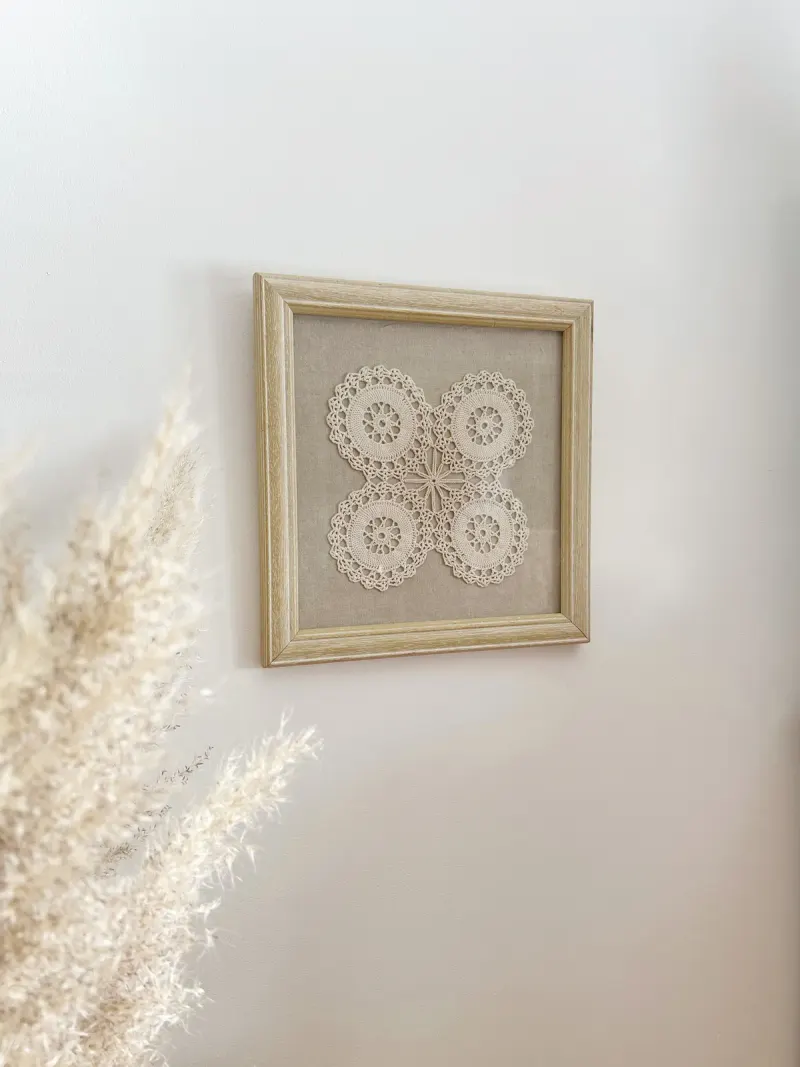
1. Preserving Lace: Doily in a Frame
Perhaps the most respectful and protective thing you can do with a cherished vintage doily: encase it in a frame. This simple act elevates a domestic item from a dresser-top afterthought to a piece of museum-quality, curated art. The frame acts as a time capsule, preserving every delicate knot, the precise stitch patterns, and the texture of the old cotton. It turns a ten-pound find (or a family heirloom) into a unique focal point. For the piece shown in photo, the doily's complex, symmetrical four-lobed design is perfectly centered, creating a sense of balance and reverence.
Pro Tips for Framing Your Lace: Contrasting Backing: To make the intricate lace truly pop, use a dark or contrasting fabric backing (like a deep velvet or, as seen here, a slightly darker natural linen). This provides depth and makes the subtle details of the off-white thread visible.
The Vibe: When we sell our larger, more "boho" woven macramé hangings in the shop, they have a certain energy. A framed doily, however, offers a completely different, quieter mood: one of preservation, curated history, and soft, domestic elegance. It feels less like a quick décor trend and more like a cherished piece of family history (even if it's not yours). It’s "grandmother's-cottage" refined.
2. Stretch a doily over a hoop and hang it from the ceiling
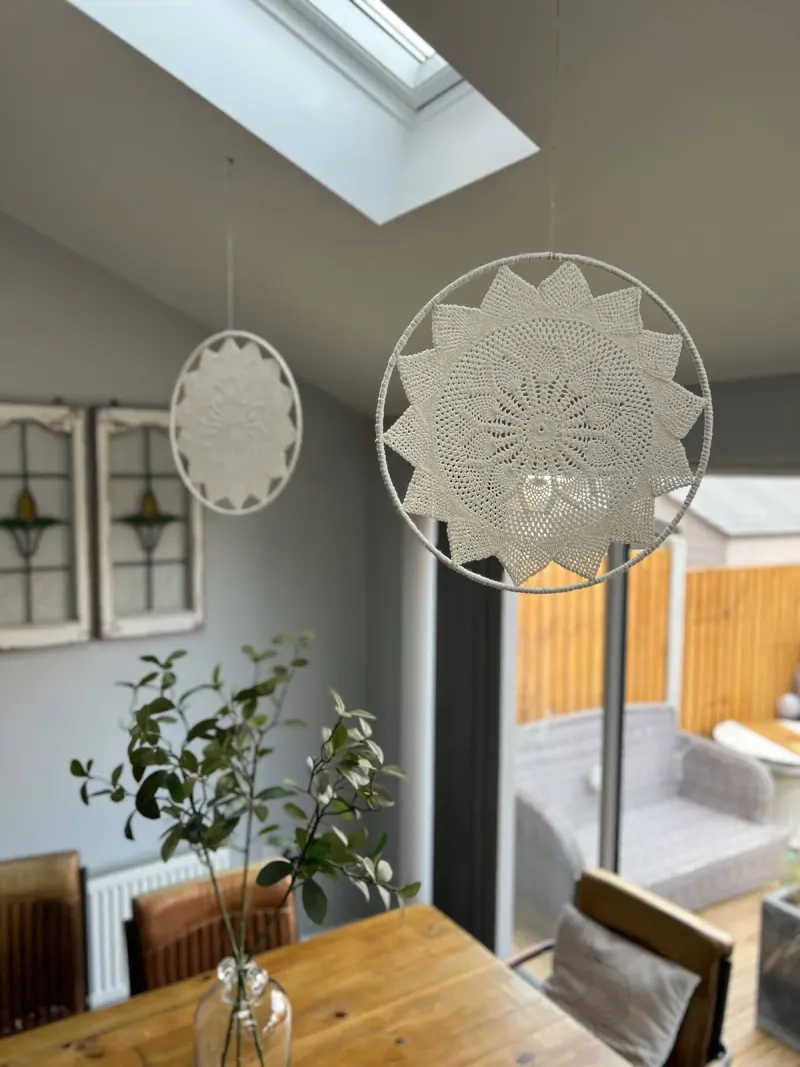
This one is my favourite trick. A larger circular doily, gently stretched over a metal or bamboo hoop and suspended from the ceiling on a near-invisible thread, becomes a slow-moving piece of light. Hang it near a window or under a skylight and it casts soft lace shadows on the wall as the sun moves across the room.
You'll need a hoop a couple of centimetres bigger than the doily so the lace tensions evenly when you whipstitch it around the rim. Two or three together at slightly different heights are better than one — the eye reads them as a small flock.
A pair like the ones above sits in our dining area. They move very slightly in the draught from the back door, and the light through them changes all day.
3. Build a boho dreamcatcher with macramé and feathers
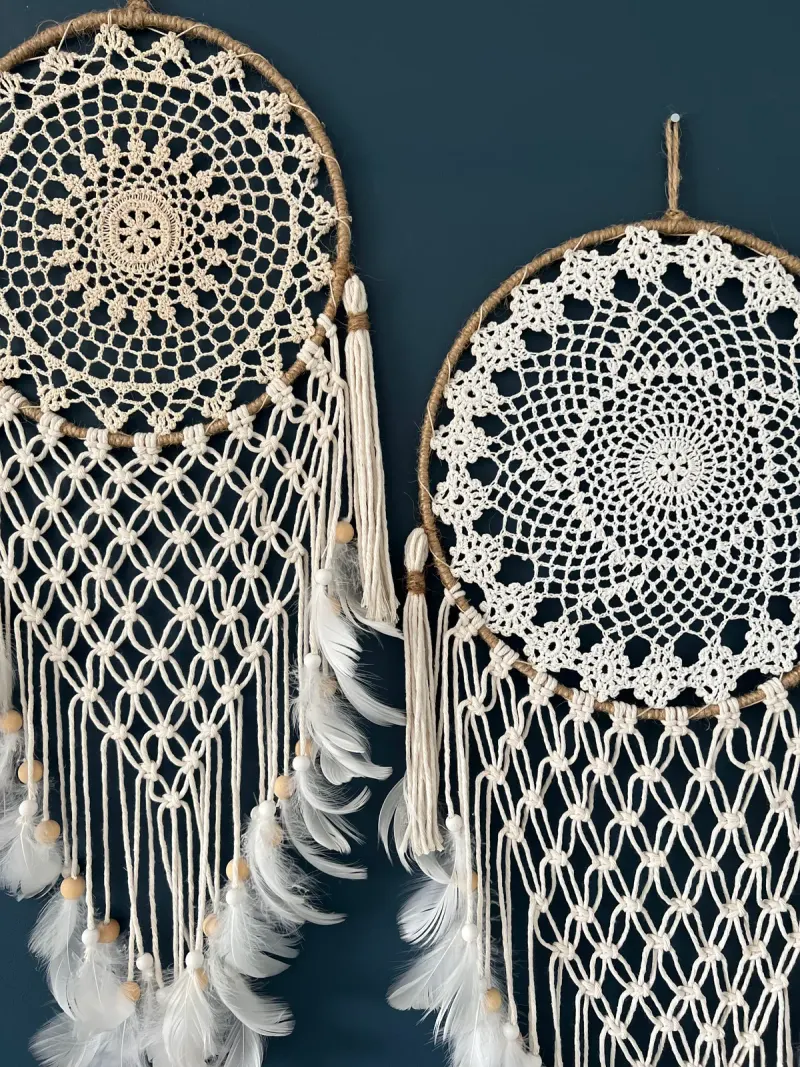
If you already make a little macramé, you'll see this one immediately: the doily becomes the centrepiece of a dreamcatcher, with knotted cotton cord and feathers cascading below. The combination softens both — the lace anchors the knotwork, and the macramé gives the lace something to do.
Work the doily onto a wooden or metal hoop first, then knot your fringe directly onto the bottom half of the hoop so the cords drop naturally. Add a few real or faux feathers at the ends of the longest strands. The piece looks intentionally bohemian rather than craft-fair-cluttered if you stick to a single colour palette — natural cotton, jute, and cream feathers, nothing variegated.
4. Or skip the macramé and let the doily be the whole story
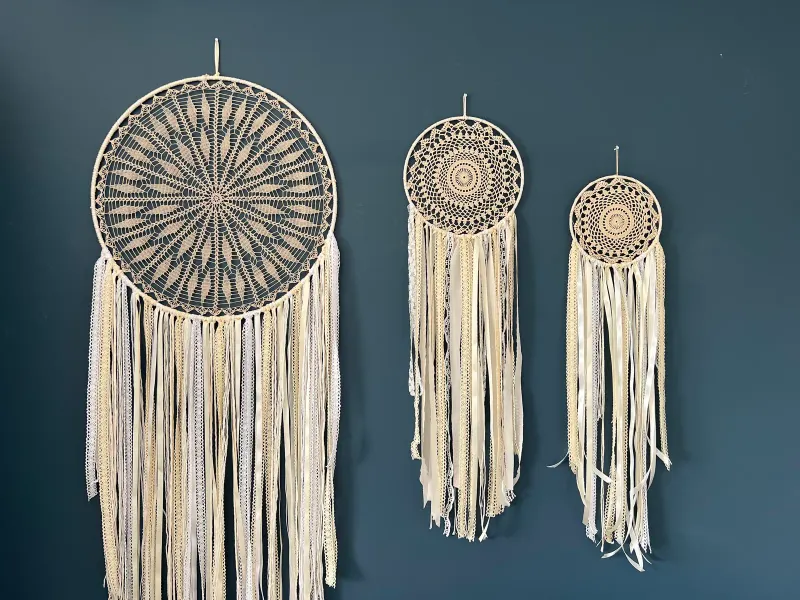
A simpler take: doily centre, long ribbon-and-lace tassels straight down, no fringe. Mounted on a dark wall in graduated sizes — large, medium, small — it stops looking like one craft project and starts looking like a small gallery wall.
This is the version we recommend for hallways and stairwells where you want a vertical line of soft texture without anything bulky. The dark wall is doing as much of the work as the doily; on a pale wall the contrast disappears and the lace looks washed out.
5. Mount a single mandala doily on a beaded hoop
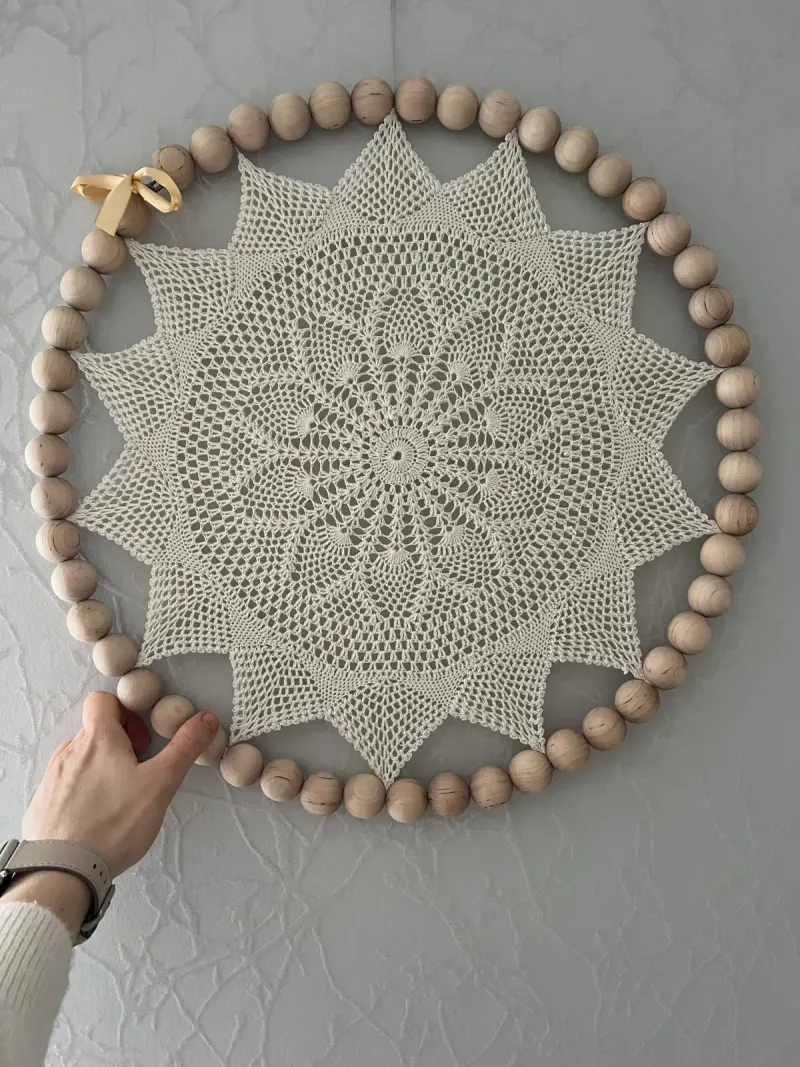
If you find one truly spectacular doily — the kind with a complex pinwheel or sunburst pattern that took someone a hundred hours to make — it deserves to be the only thing on the wall. Stretch it across a wooden hoop and ring the hoop itself with light wooden beads strung on jute. The beads frame the lace and pull warm tones through the whole piece.
Hang it on its own at eye level above a console table or in a reading corner. Don't crowd it. A piece this detailed earns the negative space around it.
6. Turn a small doily into a Christmas shadow box
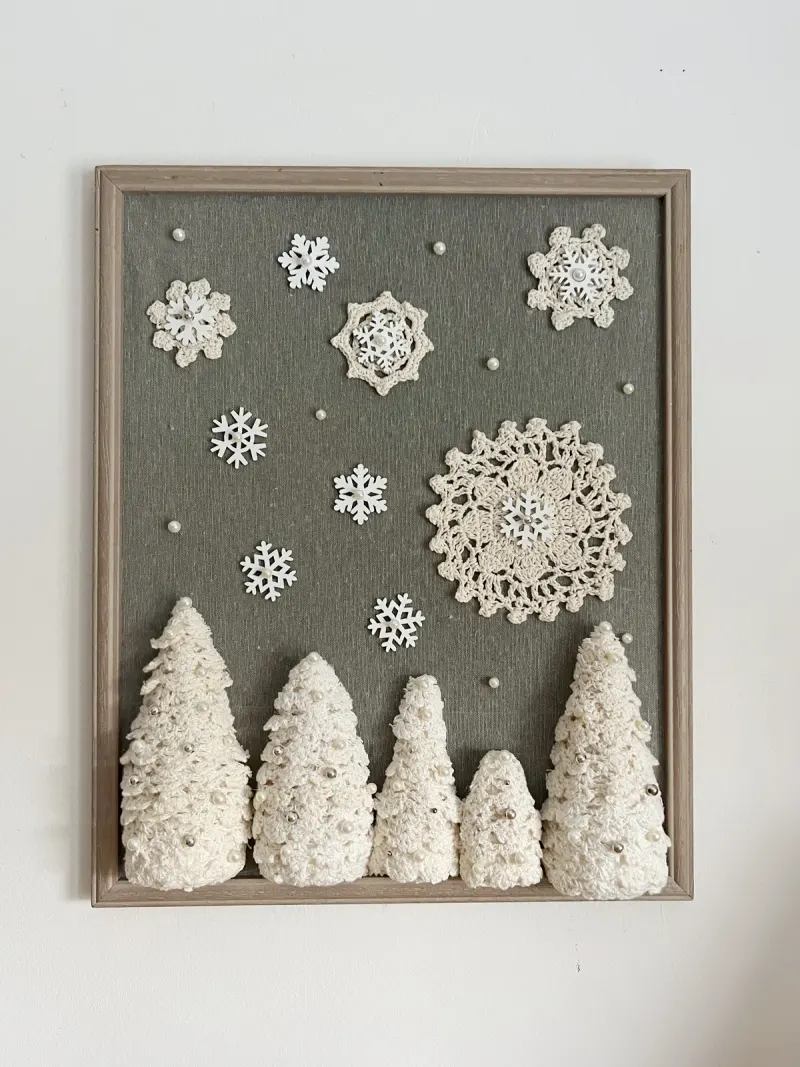
This is a seasonal project I make every November. A grey-linen background, three small crochet doilies arranged as snowflakes (with little white wooden snowflake accents tucked between them), pearls scattered like falling snow, and a row of cream cone trees along the bottom. All inside a deep box frame so it sits proud of the wall.
It looks more expensive than it is, and the doilies are actually the easiest part of the build — the cone trees and the pearl placement take far longer than stitching the lace down.
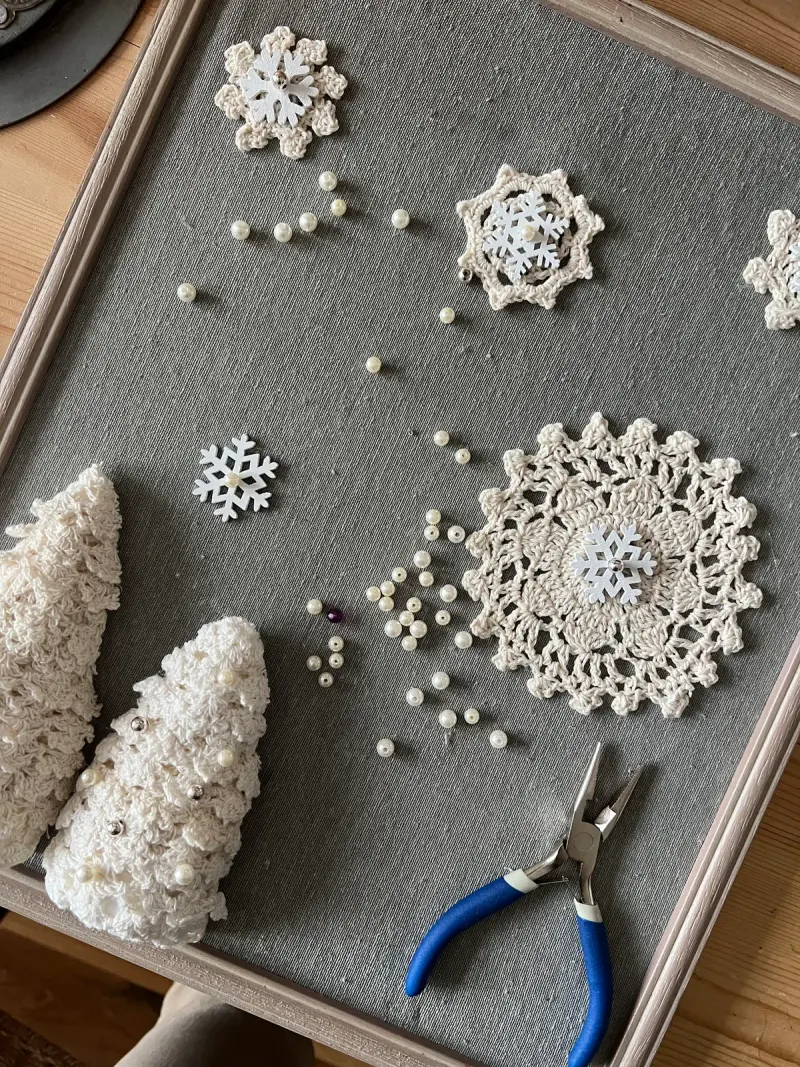
A peek at the build in progress, above. The pearls are pinned in place individually with tiny dressmaker's pins, which is fiddly but worth it — anything stuck on with glue ends up looking flat in photographs and in person. Slow craft is faster than it looks; you just notice every minute of it.
7. The Doily Decoupage Lampshade
Perhaps the most transformative way to rescue a collection of vintage lace is to layer them onto a plain, old lampshade. By gluing several doilies of different sizes and patterns across the surface, you create a rich, textured collage that turns a basic household item into a glowing work of art.
When the lamp is lit, the light filters through the overlapping knots and floral motifs, casting intricate shadows that you simply can’t achieve with a mass-produced shade. A tired, budget-friendly lamp instantly becomes a high-end focal point with a story to tell.
Pro Tips for Your Lace Collage: Safety First: Always use a low-wattage, warm LED bulb. Old cotton and delicate lace can be sensitive to heat, and LEDs keep the shade cool while providing that perfect amber glow.
The Perfect Fit: If you have a tapered or unusually shaped shade, don't worry about finding one giant piece of lace. Instead, overlap smaller doilies to "shrink-wrap" the curves, using a bit of fabric glue to secure them in place.
The Vibe: While sleek macramé shades offer a modern "hotel-lobby-boho" look, a decoupaged doily shade feels much more intimate and nostalgic. It’s pure "grandmother’s cottage" chic—soft, domestic, and utterly unique.
A small note on sourcing
You almost certainly do not need to buy new doilies for any of this. Charity shops, car boot sales, eBay job lots, and family clear-outs are full of them — usually for a pound or two. The only time I buy anything new is the wooden hoops, frames, and beads that hold the lace; the doily itself should already exist somewhere in the world before you begin.
If a piece has yellowed badly, a soak in a mild solution of warm water and oxygen-based laundry powder usually brings it back. Lay it flat to dry on a clean towel — never put a delicate vintage doily in the dryer.
Want a custom piece instead of making one?
If you've inherited a few doilies and don't know quite what to do with them, you don't have to figure it out alone. We make custom pieces from customers' own family lace fairly often — framed clusters, hoop sun catchers, Christmas shadow boxes, and lampshades, all built around the doilies you've been keeping for someone to use again. Get in touch with a few photos and we'll talk it through.
Whatever you do, please don't throw them away.